
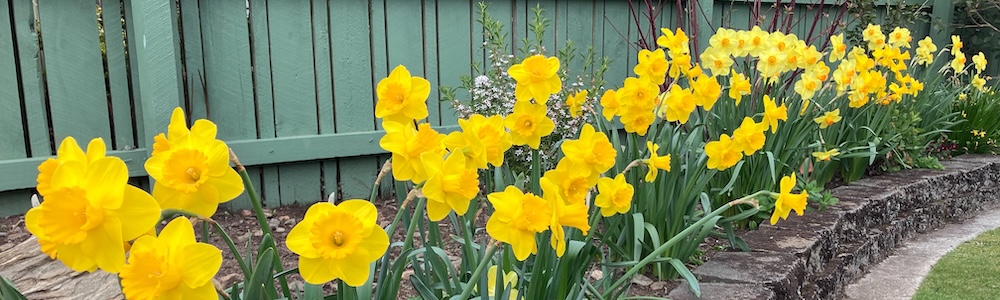
A Week of Extreme Weather In October
Hello friends,
October is usually a tumultuous month for us here in Dunedin, with the weather swinging in extremes from hot north westerly gales, to cold southerly fronts, including the threat of possible snow and frost, and this October was definitely no different from previous years regarding this.
In the third week of October we were warned of a spring north westerly wind storm approaching, and the resulting weather watches and orange wind warnings from Metservice had me worried.

In preparing for the north westerly wind storm, it first meant picking up anything outside that could go airborne, including my frost protection buckets (I lost one in the wind, but I eventually found it days later), taking down our bird feeders, moving our patio furniture to a more protected spot, putting our wheelie bins into the woodshed, and tying the glasshouse doors shut as they face the North West.


I also took the precaution of moving my most precious plants out of the glasshouse and into the garage for extra protection. I just couldn't risk losing our tomato plants, and dahlias in pots due to something unforeseen happening, like our glasshouse blowing away.
The big north westerly wind storm itself was frightening, and our house shook and shuddered for hours, first with the North Westerly gales, and then the Southerly front behind it, which took out our grid power for 8 hours. Luckily, we have solar panels on our roof, and a solar battery in our garage, and this system kept our house powered during the blackout (our battery has a storm watch function, and as soon as Metservice sent out the orange wind warning, the system began charging the battery to 100%). We are now very glad we invested in a solar system a couple of years ago.


All around Dunedin mature trees were blown over, trampolines went flying, fences were blown over, and the roofs of houses were lifted off. Many people in the lower South Island lost power for hours, and some for days, and even weeks.
Unfortunately, there were two casualties in my garden from the north westerly wind storm. My Avalanche camellia in the backyard garden snapped off at its base, killing the plant. It was only a year old, and didn't have a thick trunk yet, and it looks like it bent over in the wind until it just snapped. The only good thing about this happening is that it has given me one extra spot to plant a dahlia in this summer, but I am sad that I lost a beloved plant...
And the second casualty, was that my quince tree lost two north west facing tree limbs. They snapped partially off, so I had to trim them back to the nearest healthy branch on the tree. My quince tree is only 3 years old, so it won't suffer from losing a couple of young tree limbs. Thankfully the quince fruit forming on the tree didn't fall off during the storm.


With the north westerly wind storm over, it was time to clean up the garden of plant debris, reinstate our garden furniture to the patio, return the bird feeders to their rightful places, and transfer my precious plants sheltering in our garage back to the glasshouse.
The weekend after the north westerly wind storm was Labour Weekend, the traditional time to plant everything out in the vegetable and main gardens, but I was wary of doing this because Metservice forecast a cold southerly system occurring, with the potential of snow to low levels, and a frost afterward. I refused to risk planting out all my plants into the garden that weekend, only to have to frost cloth them for nights afterward.
So instead of spending the entire Labour weekend out in the garden planting out everything, my plants stayed safely inside the glasshouse where it was definitely warmer than outside, and I watched as the cold weather arrived...
And thank goodness I listened to the Metservice forecast, because the predicted low level snow fell, and settled to about 200 m above sea level in the hills surrounding us, and our temperature dropped to 1.1˚C overnight.


The dahlias growing outside were protected by their frost protection buckets, and all the plants in the glasshouse was protected by a number of layers of frost cloth. After a couple of days the weather warmed up back to early November temperatures, and it was time to plant stuff out in the garden, but it adds to my growing evidence that late October/early November is a risk to my Labour weekend gardening plans.
Have a wonderful day
Julie-Ann
Want to discuss my post? Feel free to chat with me on Instagram or Mastodon or Bluesky.
How To Keep My Outdoor Dahlias Alive During Spring Frosts
Hello friends,
We're at the time of the year when the days are getting longer and warmer, and my dahlias in the ground are starting to wake up and poke their heads above ground. This is a good thing, but it is also very stressful because spring weather in Dunedin can be quite fickle.
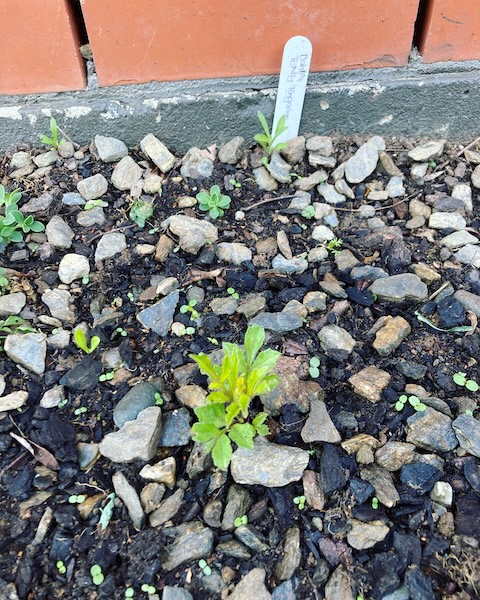
It used to be that you could plant temperature sensitive crops of all types in Dunedin at Labour weekend, which is in the third weekend of October. But for the last three years we either have had a snowfall in the last week of October, or we have a very late frost in the first week of November. As this is a death sentence for any dahlia growing in the garden, I've had to come up with a frost protection method which will work for all my dahlia plants.
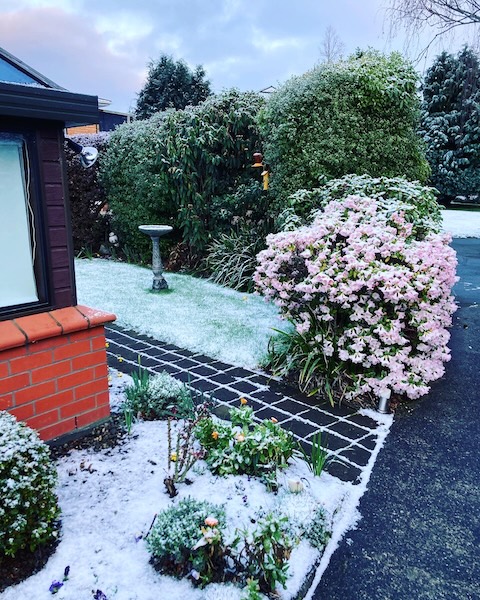
Over the last couple of years I've tried frost clothing my dahlias, but this method is prone to the wind blowing the frost cloth off overnight before the frost at dawn. So I've had to resort to a more brute force method of protecting my dahlias. After many trials, I finally settled on using a lot of small, cheap buckets, placing them on top of the dahlias on risky nights, and holding them in place with a spare piece of firewood.
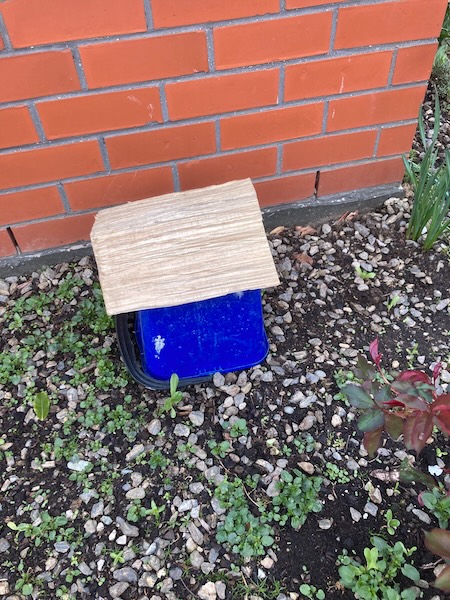
It's not a very pretty method, but it does the trick. It does take a lot of work though, going around each night putting buckets on dahlias, and then the next morning removing them when the temperature rises. Larger buckets are needed to protect the dahlias as they get bigger. Then there is the problem of running out of buckets if too many dahlias are above ground, and I'm not proud to admit this, but that's when I resort to raiding the kitchen cupboards for ice cream containers and mixing bowls...
I used to go around with a wheel barrow collecting up all the buckets and firewood each day, and then redepositing them each night, but now I've gotten lazy, and leave them sitting beside each dahlia all the time for easier distribution. It may make the garden ugly looking for about a month, but I can totally live with that.
The whole process is a giant pain in the ass, but it's completely worth it in summer when my garden is filled with flowering dahlias.
Have a wonderful day
Julie-Ann
Want to discuss my post? Feel free to chat with me on Instagram or Mastodon or Bluesky.
Our Weather Station, and Our 2023 Weather Data
Hello friends,
With it now being the new year, I can now share the 2023 weather data from our home weather station. I like to track the weather each year, so I'm aware of trends like first and last frost date, snow, and also how much rainfall we're getting.
Up until March last year, I had been using nearby weather stations for our data, but when the two closest weather stations shut down, it was time to once again invest in a weather station of our own. We had a weather station when we lived in Wellington, but my husband accidentally smashed it when he chopped down a tree on our property (I did suggest before he chopped the tree down that we should move the weather station out of the way, but he said it would be fine...).
After much research last year we chose the Ecowitt GW1101 WIFI weather station, which has a 7-in-1 Outdoor Sensor Array: (wind vane, wind cups, UV / solar
radiation sensor, thermo-hygrometer sensor, and rain gauge), and a USB Wi-Fi Gateway. The WIFI gateway lets you import your weather data in a number of ways, and we chose to import the data onto our local server, and hubby made a local web interface for looking at the data. We also chose to add on a number of other sensors to the WIFI gateway, so we also have four soil water sensors, and a PM 2.5 air quality sensor. We currently have one soil sensor in our glasshouse, and the other three under each citrus tree we have. The air quality sensor is installed between us and our neighbour who has a very smoky woodburner. We have also just purchased two water leak detection sensors to add to our system, as we got a leak in our roof space last week, and had water coming down from our garage ceiling. We're going to place the sensors near our old hot water cylinder, and also near the garage in the roof space as an early warning system for the future.
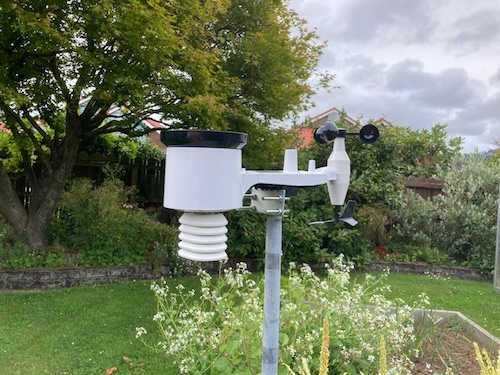
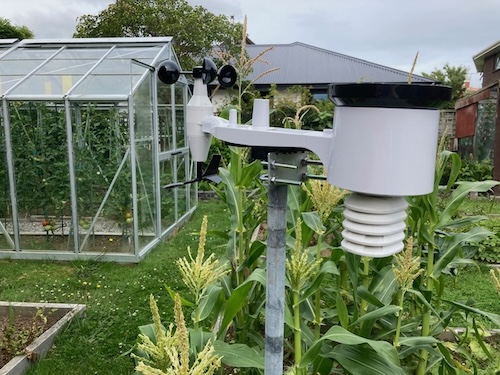
We positioned our weather station in one of our vegetable garden beds, as it was away from lots of heat sinks like the house and concrete paving, and we reused the pole from our old TV aerial to mount it in place.
In this blog post, I will be sharing the general weather data that was collected during the 2023 year.
Yearly Weather Totals:
Lowest Temperature of the Year: The lowest temperature for the year was -6.8˚C, which happened on the 8th of June 2023. This temperature occurred during a week of heavy frosts, we had 7 days of no wind and clear nights. This temperature happened on the third day of frosts in that week. This frost was responsible for killing one tree, as all the leaf buds had been heavily damaged. This cold weather led to very high PM2.5 air quality readings in all of Mosgiel, and we had to have two air filters running inside the house to keep the air clean.
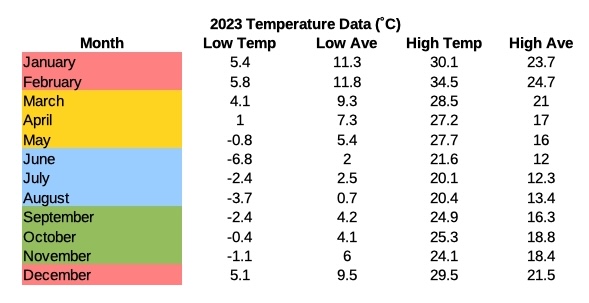
Highest Temperature of the Year: The highest temperature for the year was 34.5˚C, and this happened on the 2nd of February 2023. This happened on a summer day where we had strong North Westerly Foehn winds. This NWer Foehn wind set up is common in Dunedin before a Southerly arrives, and this can happen at any time of the year. NWers are common in winter just before a winter snow storm from Antarctica, so the temperature change can be quite drastic within a day.
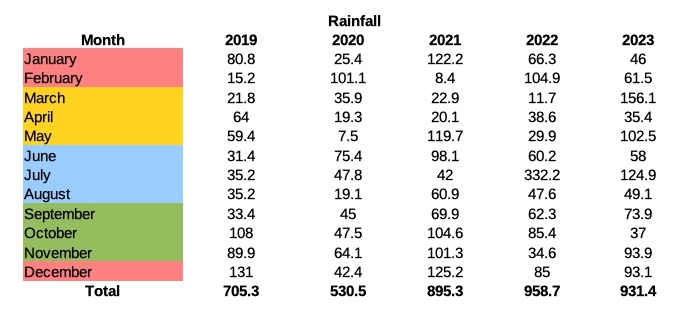
Rainfall for the Year: This year we had a rainfall total of 931.4 mm rain. March was unexpectedly rainy, it's usually one of the driest months of the year in mid autumn. January 2023 was particularly sunny and dry, and we were on water restrictions until March.
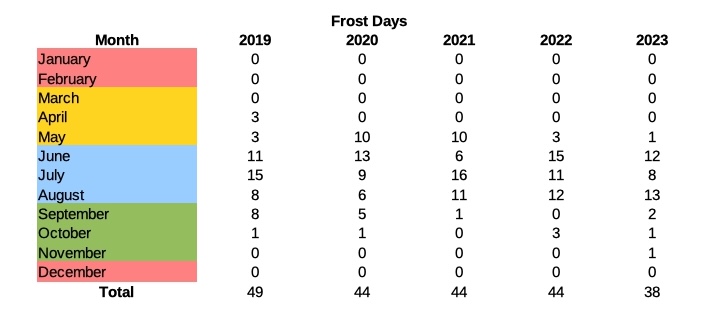
Frost Days: Here in Dunedin it's cold in winter, and we get a large number of frosts, which is good for killing off pathogens in the garden, and helping fruiting in trees and bushes like apricots, cherries, and blackcurrants. We had 38 frost days in 2023. The first frost was on 22 May 2023 and was -0.8˚C, and the last frost was on 10th November 2023 and was -1.1˚C. The last frost date was particularly terrible, as it was well past the date where it is assumed plants growing in the vegetable garden would be safe, and I lost many vegetable plants including beans and pumpkins. My grandad always told me it was safe to plant vegetable plants outside from Labour day weekend, and that's the date I use in planting frost tender plants. You can find an in depth blog post on the November frost here.
I've included other Frost Days in the years since we moved into our home. As you can see in general, the first frost is usually in May, and the last one in October. The last frost in November 2023 is an outlier.
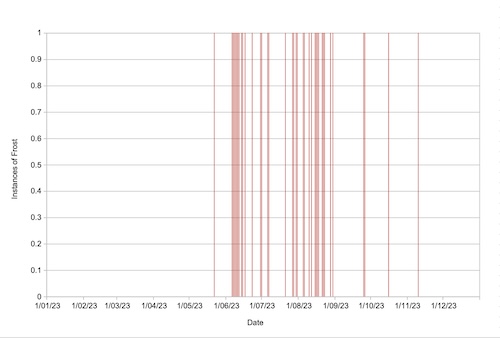
As another way of visualising the frosts in 2023, I've graphed out each instance of frost against time for 2023. There are distinct clumps of frost occurring throughout the year, and they usually happen after a southerly front has gone through.
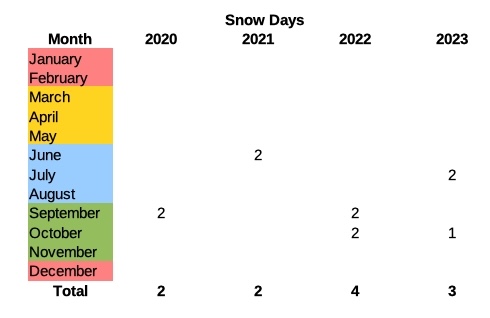
Snow Days: I count snow days as days that we have snow falling outside our home at our height above sea level (30 m), whether or not it may settle. Snow means that a big southerly storm has gone through, and this will lead to frosts afterward. In 2023, we had three snow days, two in July, and one in October. The one in October was very out of character, as usually we get snow events between July and September.
These are the most important factors I look at in interpreting the weather data, but there is much more I could look at, for example comparing frost and snow days verses days that NWers come in before a Southerly storm. 2024 will be the first year I will collect data on NW days.
Do you collect your own weather data for the year? I found it's very useful for in planning in the garden. There's lots of amateur weather stations available online to collect your own weather data, but if you're a big weather geek like me, it doesn't take long before deciding to get a weather station of your own.
Have a wonderful day.
Julie-Ann
Want to discuss my post? Feel free to chat with me on Instagram or Mastodon.
Spring Seed Sowing Week 1
Hello friends,
We're now into the last month of winter, and it's finally time to start sowing seed for spring. It's a tricky time of the year, as it's possible to get snow here in Dunedin even into the first week of October, so there's nothing worse than sowing seeds too early, and then having to try and keep them alive if there's a late frost or snow in early October. Last year we had snow laying on the ground the first week of October, and a couple of frosts the weeks after that, so it was a stressful time trying to keep all my seedlings alive, looking after my growing potato plants, as well as my new dahlias which had just popped out of the ground. Seedlings don't get transferred outside and into the vegetable garden until Labour Weekend, which is the third weekend of October, so that's a long way off right now.
I have a specific order in which to germinate seeds, so that I don't have too many plants sitting in the glasshouse for such a long period of time. The first seeds sown are my tomato plants. I grow enough plants for our own needs, but also for family members as well. I usually have at least 12 plants growing in our glasshouse, and poke any others that are spare in free space I have in the vegetable garden. We eat a lot of tomatoes fresh throughout the summer, but the bulk of it is frozen away for using in autumn and winter cooking.
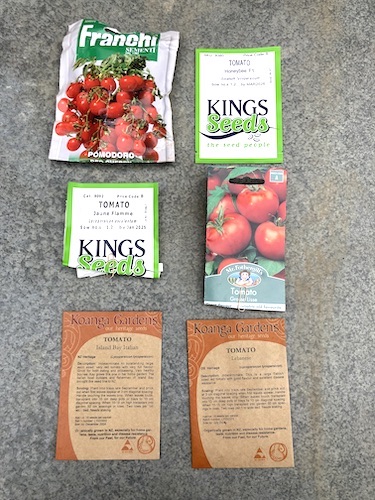
This year I'm growing the following tomato varieties:
Franchi Sementi Pomodoro Red Cherry - A red cocktail tomato with great taste. This is no longer for sale in New Zealand, I save this seed every year.
Kings Honeybee F1 - I haven't tried this one before, I wanted to try another cocktail tomato, we'll see how this goes. One of my sister's grows her tomatoes outside, and it's far easier to ripen smaller tomatoes in Dunedin's short summers.
Kings Tomato Juane Flamme - Our favorite tomato, an orange tomato with the best taste of any tomato I've ever grown.
Tomato Grosse Lisse - A beefsteak tomato that was a favorite of my grandfather. The best tomato for putting a slice on a hot piece of toast, and eating it with a pinch of salt on top.
Tomato Island Bay Italian - I haven't grown this tomato variety before, but I've heard good things about it. Good for eating fresh and processing apparently.
Tomato Lebanese - Also a new tomato variety this year, I'm hoping it will have good disease resistance, and tastes good too.
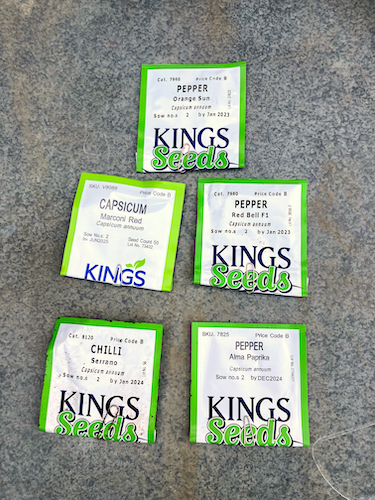
The next seeds to be germinated are my chilli and capsicums plants. I've successfully grown chillies in our greenhouse, but I haven't had any luck with the big traditional bell pepper capsicums.
This year I'll be growing the following chillies and peppers:
Chilli Serrano - I had a huge crop of chilli last season, so I'm growing this variety again.
Alma Paprika Pepper - Trying once again to grow my own paprika. Last season they didn't grow as well as I hoped, am trying again for the last time.
Capsicum Marconi Red - A prolific sweet Italian variety. I'm hoping that it's narrow shape will mean it ripens faster.
Capsicum Orange Sun - My last attempt at growing a bell pepper variety.
Capsicum Red Bell F1 - Also another last attempt at successfully growing a bell pepper variety.
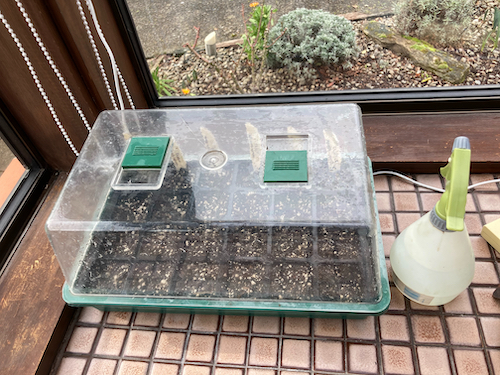
The tomato and chilli seeds were sown into two mini greenhouses, and placed in a warm sunny spot in our dining room. It's warm in there on sunny days, and also thanks to the benefit of our wood burner being in that room, they're kept warm in there every night in winter. I'm eagerly waiting for the seeds to germinate.
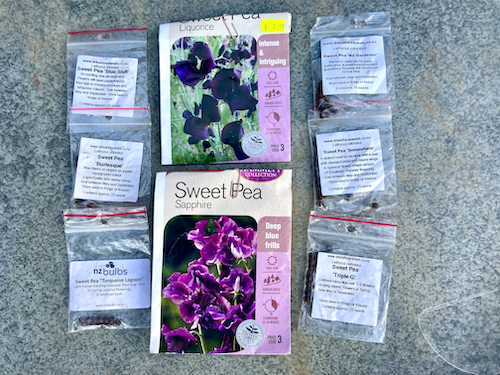
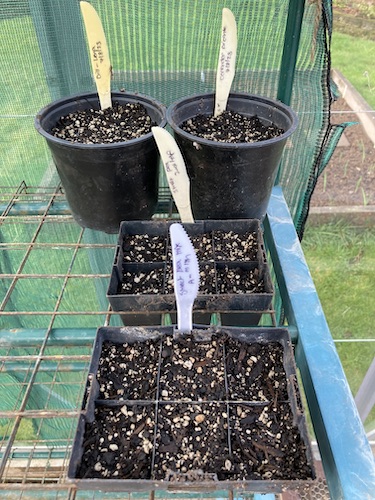
The next seeds to be sown are all my sweet pea varieties. I've collected quite a lot of Keith Hammett varieties over the years, he's a New Zealand breeder who produces the most stunning sweet peas. Sweet peas germinate in cool temperatures, so they are now potted up and put into the glasshouse.
The last of the seeds to be sown for now are the herbs coriander and dill. Coriander prefers to grow in cool temperatures, otherwise they will bolt, so I sow one lot in late winter, and another in early autumn. They don't like to have their roots disturbed while planting into the ground, so I sow a bunch of seeds into a biggish pot, and then when it's time to transfer them into the herb garden, I plant the whole container worth in one spot, I don't separate out the seedlings at all. For the dill seeds I do the same thing as with the coriander, it ensures I get a relatively big crop of leaves without the problem of using up a lot space.
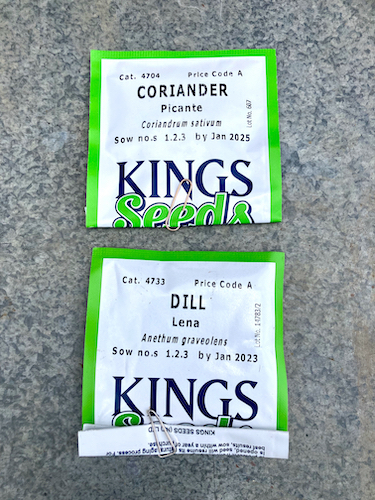
The sweet peas, coriander, and dill are all now sitting in my glasshouse. We're were expecting snow down to 200 m last night, so I've put off doing any more seed sowing tomorrow. Hopefully soon they will be joined by a lot more seeds as the month goes on.
Have you started seed sowing yet? I'm interested in what choices you've made for the coming growing season.
Have a wonderful day
Julie-Ann
Want to discuss my post? Feel free to chat with me on Instagram or Mastodon.
Social Media



Archives