
Saving Dahlia and Zinnia Seeds for Next Season
Hello friends,
Over late summer and early autumn, I spent many happy hours collecting seeds from the dahlias in my garden, and from the Floret zinnia varieties growing in my zinnia patch.
This year, my focus was on saving seeds from as many collarette and anemone dahlias as possible, along with seeds from some of my favourite seedling dahlias from this season. There's always something hopeful about saving dahlia seeds. Unlike tubers, the seedlings won't grow true to their parents, and that's part of the magic. Every seed has the potential to produce something completely new, making each growing season full of anticipation and surprises.
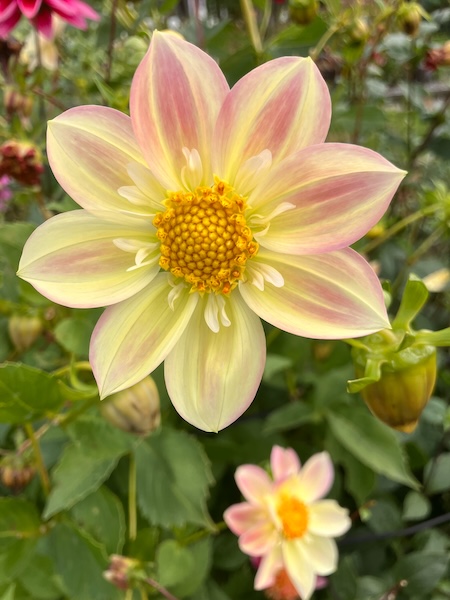
The process of saving dahlia seeds takes a little time and patience. Once a flower has finished and the petals have fallen, the waiting begins. Not every flower produces a good seed head, so I watch carefully for those that develop into plump, full seed heads.
Once I find one, I mark it with a piece of flagging tape and leave it on the plant to mature. Depending on the weather, this can take anywhere from a couple of weeks to a month. As the seed head ripens, it gradually turns a mid to dark brown colour, becomes dry and crunchy to the touch, and the outer sepals begin to pull back, revealing the inner parts of the seed head.
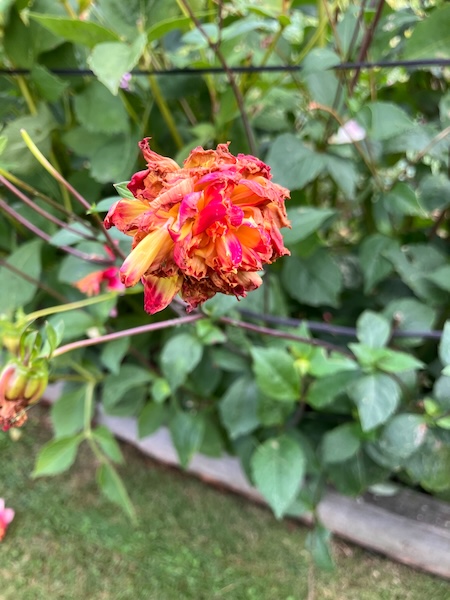
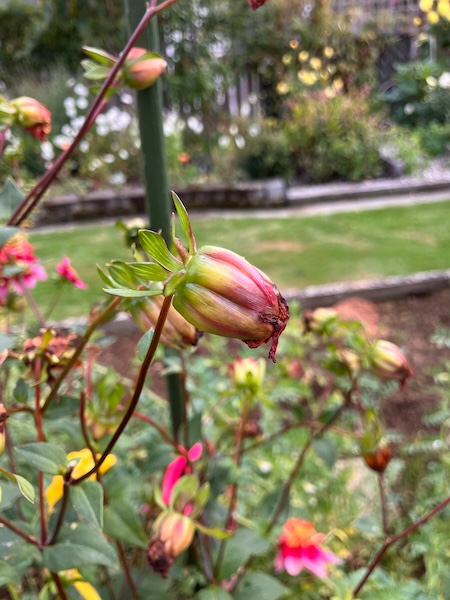
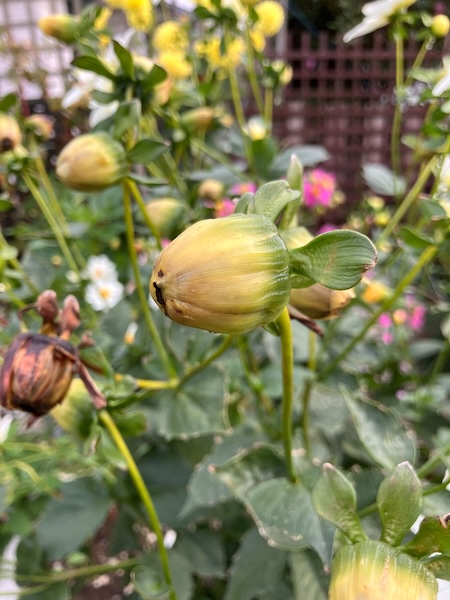
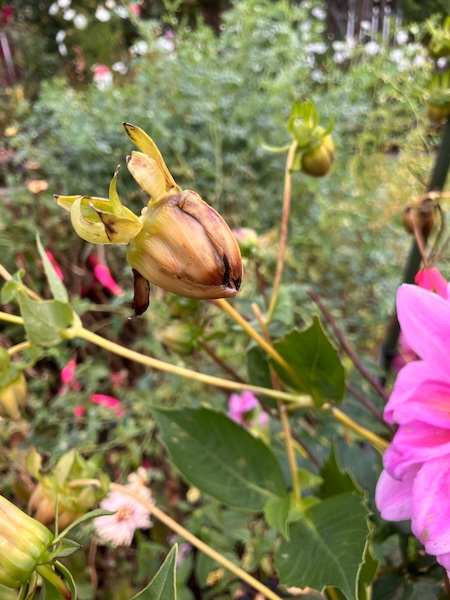
At this stage, I remove the seed heads from the dahlia plant and place them in an open container labelled with the variety name. I then gently break up the seed heads by hand to increase the airflow around the seeds. As the seed head falls apart, the dahlia seeds begin to separate from the chaff, and I leave everything together in the container to dry for a couple of weeks.
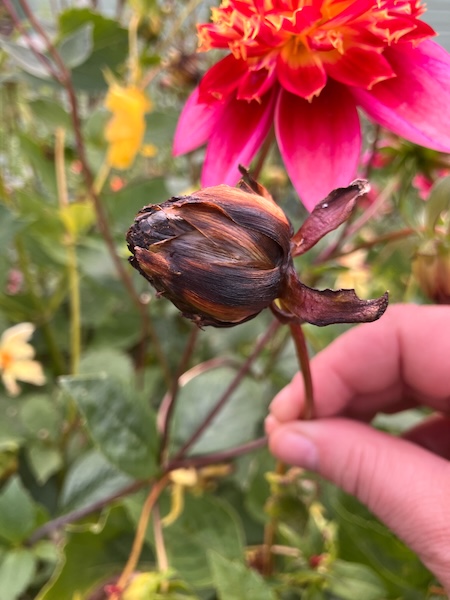
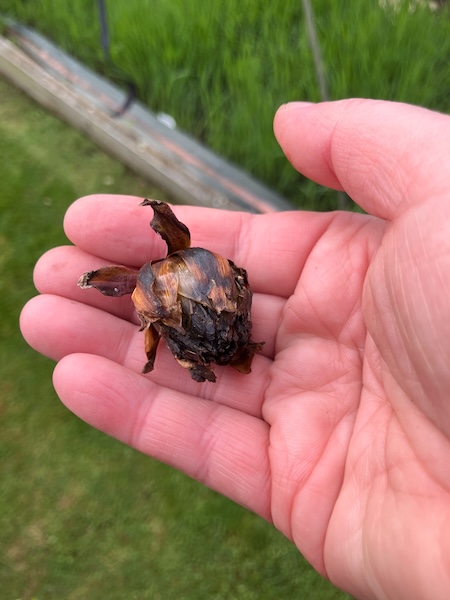
Once the seed heads are completely dry, it's time to separate the dahlia seeds from the chaff. Fortunately, the chaff is both larger and lighter than the seeds, which makes the job a little easier.
There are a number of ways to do this. One method is simply to shake the container, allowing the heavier seeds to settle to the bottom while the chaff sits on top. Another option is to winnow the crushed seed heads on a windy day, or in front of a fan. The heavier seeds drop into a waiting container, while the lighter chaff blows away. A third method is to use a soil sieve, which screens out the larger pieces of chaff while allowing the seeds to fall through.
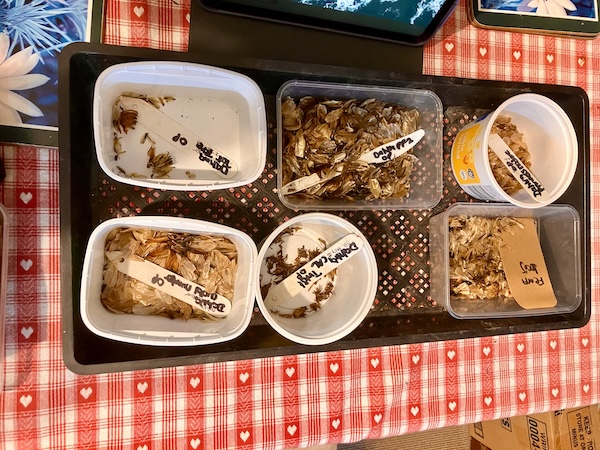
Most of the time I use the first method, as I've found that viable dahlia seeds can sometimes remain attached to the chaff. If I wasn't paying attention, it would be all too easy to throw away perfectly good seeds.
Before I begin, I make sure the seed heads are crushed up as much as possible. I then gently shake the container from side to side, allowing the heavier seeds to settle to the bottom while the chaff rises to the top. As I remove the chaff, I quickly check it for any viable seeds that are still attached and carefully pry them off by hand.
It takes a little extra time, but I'd rather spend a few extra minutes cleaning the seeds than accidentally lose some future potential favourite dahlia varieties.
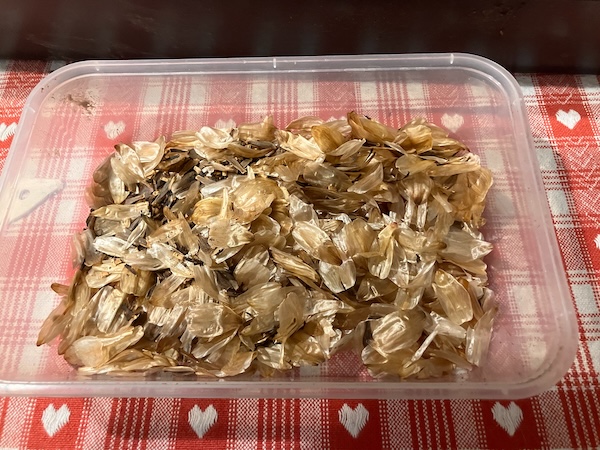
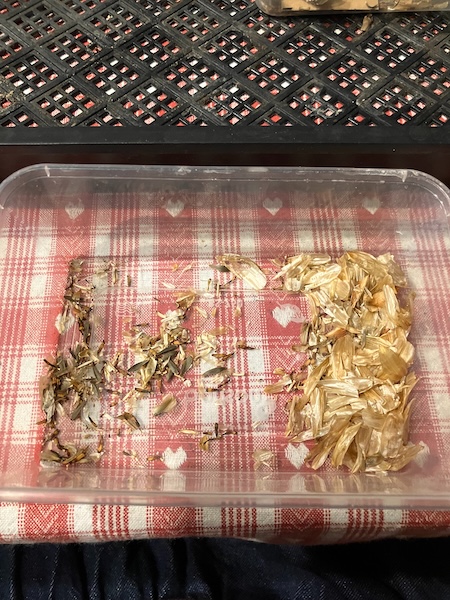
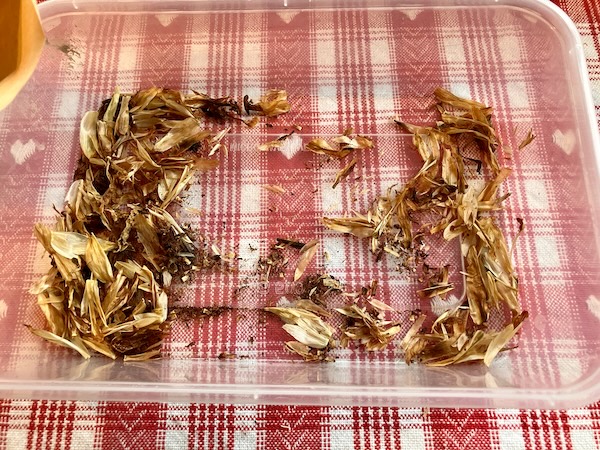
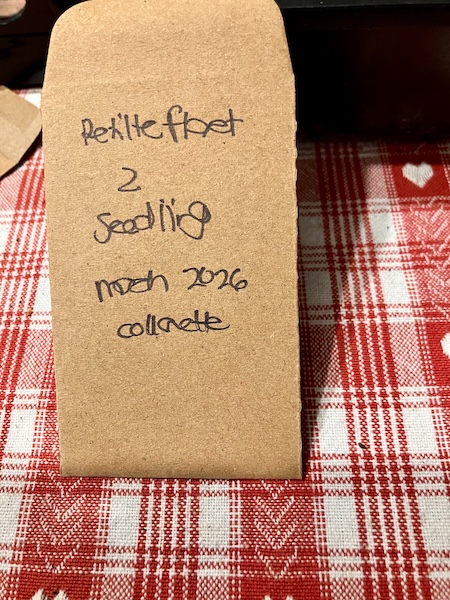
Once all of this is done, I pop the dahlia seeds into labelled paper seed envelopes. I like to include the dahlia variety, the flower type, whether the seed was open or closed pollinated, the pollen parent (if I know it), and the date the seed was collected.
With everything labelled and safely stored away, the seeds are tucked away until spring, when the whole process begins again. One of the things I love most about growing dahlias from seed is that each seed holds the possibility of something completely new, and I can't help but wonder what surprises next season will bring.
My approach with the Floret zinnias in my zinnia patch (Precious Metals, Unicorn and Blush) was a little different. Rather than selecting individual plants, my aim was simply to collect as many viable seeds as possible from across the patch.
Because Floret zinnia seeds were only available in New Zealand for one season in 2024, I have no way of purchasing more seed. If I want these beautiful varieties to remain part of my summer garden, seed saving is really my only option.
Thankfully, zinnias are generous plants, and with a little effort I hope to carry these favourites forward for many summers to come.
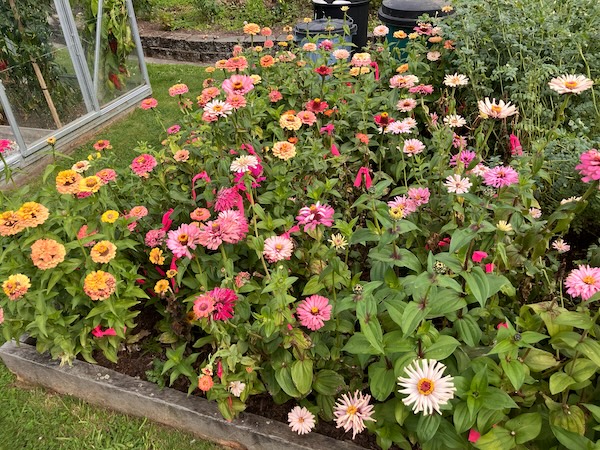
Last spring, I sowed all of the remaining Floret zinnia seeds I had in storage and grew them on through the season. By late January the first flowers were appearing, and I began saving seed in February.
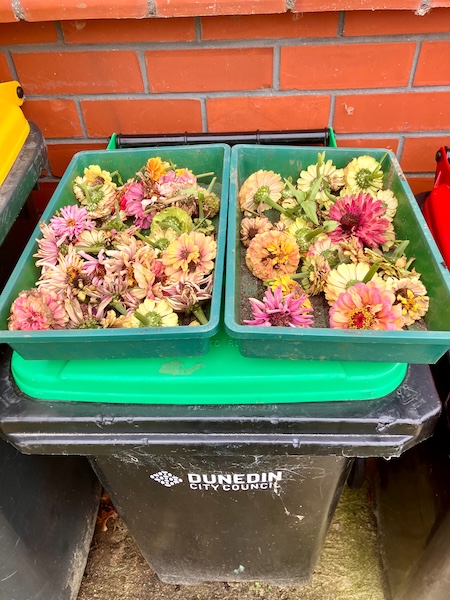
Fortunately, many of the plants set seed well, and before long I had collected trays of mature brown seed heads. Then, in April, just before our first decent frost, I harvested as many flower heads that had begun setting seed as possible, hoping that some of them would continue to mature and provide a few extra seeds as well.
With Floret zinnias no longer available, I was keen to make the most of every opportunity to save seed and carry these beautiful varieties forward into future summers.
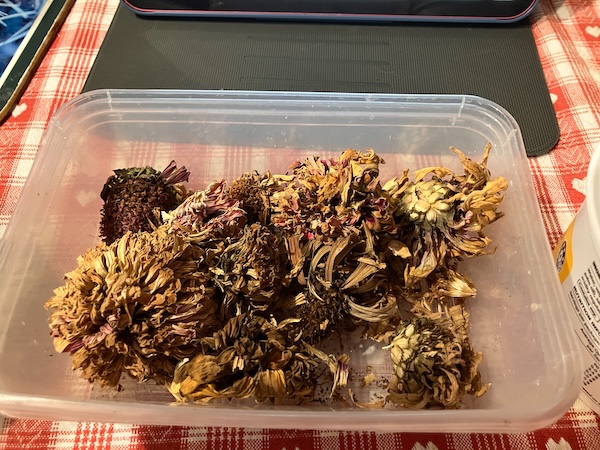
The process for collecting zinnia seeds is pretty much the same as with the dahlia seeds. I allow the seed heads to dry out completely before gently crushing them by hand. The seeds naturally fall to the bottom, and I use the same shaking method to separate them from the chaff.
One of the interesting things about zinnias is that they produce two different types of seeds. Seeds from the ray flowers are larger and rounder in shape, while the seeds from the disk flowers are much smaller and narrower. Some growers believe that the larger ray flower seeds are self-pollinated, while the smaller disk flower seeds are more open-pollinated, producing different flowers in the next generation. I haven't found any definitive evidence for this, though.
As I've collected both seed types, it would be easy enough to grow them separately and see what happens. Perhaps that's a future Crafty Gardener project waiting to happen...but that's a story for another growing season.
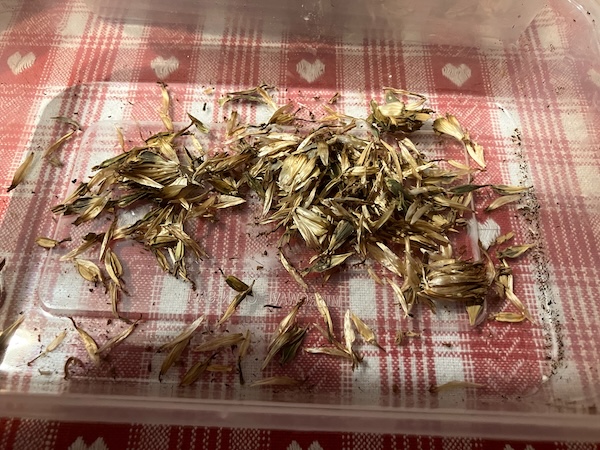
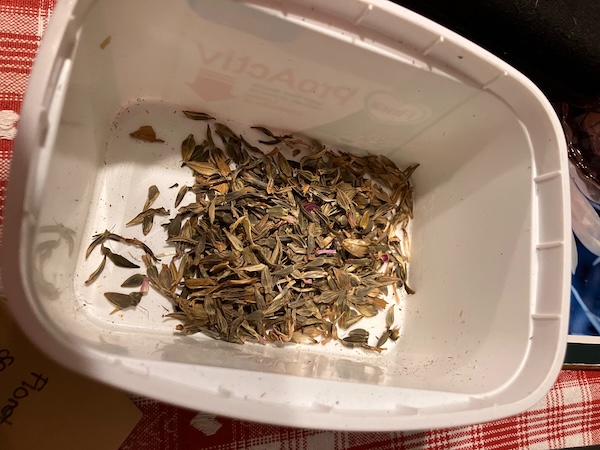
Overall, I managed to harvest over half a margarine container full of Floret zinnia seeds. They are now safely stored away, waiting patiently for spring and another season in the garden.
Both dahlia and zinnia seed saving have taken up a lot of my time throughout autumn and now into early winter, but I have many seed packets safely stored away ready for sowing in spring.
Winter has arrived, and although it is often thought of as a quieter time in the garden, I know there is still much to do. There is tidying and weeding to tackle, dahlia tubers to dig up, and a new back garden project waiting in the wings.
This will be my last blog post for the next fortnight. My husband and I have a medieval-themed wedding to attend (which means we finally get to wear our new cloaks!), and afterwards we're taking a short holiday to relax after a busy growing season.
So, until then, I'll wish you all a happy winter solstice. I'll see you again in July, at the beginning of a new gardening year, and the start of another season of stories.
Have a wonderful day
Julie-Ann
Want to discuss my post? Feel free to chat with me on Instagram or Mastodon or Bluesky, and now also Facebook.
My Floret Zinnias This Past Summer
Hello friends,
Last spring I sowed all the remaining Floret Zinnia seeds I had in storage, which I had bought from Emerden in 2024. The Floret Previous Metals, Dawn Creek Blush, and Unicorn zinnia varieties were sown into seed raising mix, grown on until they had two sets of true leaves, and then they were potted up into bigger containers with potting mix until I was sure the risk of frost was over.
I planted them in two vegetable garden beds close together, so that I could easily save seed for my own personal stash for the coming years.

And then it was time to wait for them to flower. Due to our horrible summer, which wasn't really a summer, my zinnia plants didn't begin to start flowering until late January, but they were well worth the wait. I had hundreds of flowers in such gorgeous colours ranging from cream, pinks, and orange, all the way to bright red. The range of zinnia flower types flowering varied from singles, to cactus shapes, all the way through to frilly doubles.

Dawns Creek Blush flowers varied from dusky pinks, to pinks, and to purples.


Precious Metals gave me lots of metallics in shades of orange, pinks and purples, and there was even ombré colouring in some of the flowers.


And finally, the Floret Unicorn variety gave me florescent bright pinks and orange and red flowers, with a lot of double flowers amongst them.


I was so happy with my zinnia patch, and I wasn't the only one. Bees and butterflies swarmed over my zinnias all summer and autumn long, and that made it just it that much better in my opinion.


I shared my Floret zinnias on social media, and soon found myself becoming a very small scale flower farmer, as I provided buckets of zinnias to a local flower farmer florist. I very much enjoyed going out into my garden on summer mornings to fill up buckets of zinnias to send away to their new homes.


Unfortunately though thanks to the terrible summer we had, all too soon I had to start seed saving by letting the blooming flowers set seed and turn brown. I managed to save seed from a lot of mature flowers, before the looming threat of a decent frost forced me to save as many older flowers (but not quite mature flowers) in mid-April.

On the 22nd of April we had our first proper frost, and all my lovely zinnias sparkled in the cold autumn sunrise as frost coated them all. By the afternoon the zinnia plants had all turned brown and died.


And so the zinnia season for 2025/2026 has come to an end. I have 5 trays of zinnia flower heads to process over the winter, so I can harvest the seed and store it away until next spring. I am very much looking forward to seeing which zinnia flowers bloom next summer. Zinnias are known to have complex and highly plastic genomes, and have transposons, aka jumping genes, which can lead to unstable genetics, so who knows what I'll end up with. But I'm excited to find out...
Have a wonderful day
Julie-Ann
Want to discuss my post? Feel free to chat with me on Instagram or Mastodon or Bluesky, and now also Facebook.
2025/2026 Dahlia Breeding Season Results
Hello friends,
Today I thought I'd share with you the results of the 2025/2026 dahlia breeding season.
I grew a total of 55 dahlias from seed, or as seedlings, and at the end of season only 14 dahlia seedlings remain. The number of dahlias I've kept is unusually high, and this is a result of me growing some of Floret's Petite dahlia seedlings, which I bought from Emerden last spring. They were unusually populated with promising dahlia seedlings, and this in my opinion makes buying these expensive Floret seedlings completely worth it.
To keep a track of all my seedling dahlias during the season I employed a dual system, first of all a dahlia seedling spreadsheet, and also a physical note book with a page per seedling, noting down when it flowered, what type of dahlia it was, colouring, and photos showing each dahlia in flower.


The majority of dahlia seedlings that flowered were single dahlia types, and most of those dahlias were the colour yellow. This makes sense because the single dahlia type, and the colour yellow, are both dominant in dahlia genetics according to the book "Dahlia Breeding for the Farmer-Florist and the Home Gardener". Thirty eight of the fifty five dahlia seedlings were single types, equaling a total of 69% single dahlias in my breeding experiment. Twenty seven of the fifty five dahlia seedlings had yellow flowers, or they had yellow colouring in their flowers. Both single type dahlias, and dahlias with yellow flowers, are not what I'm looking for in a dahlia in general, as they are very common, and not really interesting to me.
This dahlia seedling, SR5, is a typical yellow single dahlia flower. I don't consider it interesting at all, even though the bees love these flowers. I don't have enough space in my small garden to justify growing them every year.

And now for all the amazing dahlia seedlings I grew this last summer.
First up we have Keith Hammett Beeline II #4, a dahlia seedling from a Beeline II seed packet I bought from the dahlia breeder Dr Keith Hammett. Dr Keith Hammett doesn't have the space to grow every single seed in his breeding program, so he sells seeds packets occasionally. This dahlia is a single dahlia, but the pink to yellow ombre colour shift is just spectacular against its dark green leaves. This dahlia, KHBII #4, is very similar to Dr Keith Hammett's Mystic Sparkler dahlia, which I own and love in my garden. However, this flower is much larger, and I prefer this seedling dahlia's petal shape more, so it makes it worth keeping this dahlia for next year to see how it fares.

Next up is another Dr Keith Hammett dahlia seedling, NZ Gardener #1, which is grown from a seed packet given away by the NZ Gardener magazine. This is a yellow decorative dahlia, with great symmetry in its petals. Even though this is a yellow dahlia, I haven't seen many pure lemon decorative dahlias for sale in New Zealand, and this is the only decorative dahlia seedling I grew this year. It's worth growing for another year to see how it looks over time.

This next dahlia seedling is called Floret Bee's Choice #13 (FBC#13), AKA Pink Lemonade. This is a yellow, white, and pink anemone dahlia, with unusual domed inner anemone petals. I really love its delicate colours, and it's unusual anemone shape. This dahlia is quite pretty, and has a lot of potential. I'll be growing it for the next couple of years, to see how it develops as the tuber gets older.

The next dahlia is another Floret Bee's Choice seedling #15 (FBC#15). This is another anemone dahlia variety, and it is two toned, with pale lemon outer petals, and brighter yellow inner domed petals. I've called this one Daffodil Daze, as it reminds me of the fluffy double daffodil flowers I grow in my garden each spring.

This next seedling, SR#4, is another anemone dahlia. I'm not really sure what to think of it, but I love the purple colouring. I'm willing to grow it in my garden for another year to see if it improves.

This white collarette dahlia seedling is SR #13, which I've named Snow Dancer (named for the Snow Dancer wolf pack in Nalini Singh's Psy-Changeling book series). She's such a pretty white collarette dahlia, and since I have none growing in my garden, she will make a happy addition to my dahlia collection.

The following dahlia seedling is Floret Petite #2, a magenta on magenta collarette dahlia. This is a really pretty dahlia I bought as a seedling from Emerden Garden last spring. She reminds me a lot of the Cafe Au Lait Rose dahlia, and she also has a large flower head for a collarette dahlia. She's definitely a keeper for next year, and I've collected seed from her to see what dahlia types I get from her.

This next dahlia seedling is Floret Petite #3, which is another anemone dahlia with great potential. New flowers are a very pretty smoky peach colour, and she fades to a apricot colour as the flowers age. FP#3 is definitely another keeper, and I can't wait to see how she performs next summer.


Next up is Floret Petite #4 a stunning lemon and magenta streaked collarette dahlia with white frilly petals inside. She is a stunner in the garden, and very much appreciated by those noticing her. This dahlia probably has the most potential of all the dahlia seedlings I've grown this year. I can't wait to see her flowering again next summer. I haven't chosen a name for her yet...

Floret Petite #5 is another collarette seedling dahlia, and has pointed lemon petals, and curly white inner petals. She was growing in a bad spot in the garden, and didn't get a lot of sun, so I don't think she's grown to her full potential this year. I'm going to grow her in a better place next year, and see how she fares.

And next is Floret Petite #6, my favorite of all the dahlia seedlings I grew this past year. She is a very unusual anemone dahlia, with the outer petals colour shifting in an ombre pattern from dark to light pink, and the inner anemone petals doing the same, but with gold tips. What is also interesting is her 3D shape which is very pronounced, making her look like she's wearing a poodle skirt. She is just stunning and looks nothing like any other dahlia I've ever seen. Her colouring shifts as the flowers age.


I have also kept dahlia seedling Floret Petite #8 until next year. Unfortunately Floret Petite #6 grew beside FP#8 and completely overshadowed the dahlia seedling. Because of this, the dahlia seedling stayed quite small, and it also didn't flower this year. Due to the prevalence of great Floret Petite dahlia seedlings, my plan is to grow it for another season, to see if it has potential.
And finally we have two unknown dahlia seedlings, Unknown 2 and Unknown 4, which popped up in the back garden over summer. Their parent plant I think is Dahlia Protegee, which grows nearby them, and I think when you see the comparison photos you'll agree with me.
First up is the suspected parent plant, Dahlia Protegee, which is a Keith Hammett bred dahlia. She is an ombré magenta to salmon pink single dahlia with dark leaves. This dahlia is an absolute bee magnet all summer long.

And this is Unknown #2 dahlia seedling. She has green leaves, her petals are rounded, and her petal colouring is a deep pink ombré fading out to a baby pink outer. There are also dark pink streaks throughout her petals. When this dahlia flower ages, the light pink fades to a white shade which is really pretty.

And this is Unknown 4 dahlia seedling. She has fewer petals, green leaves, but has more of a pure pink ombré effect. There are also streaks of darker pink running through the leaves. She is also very pretty.

As you can see from these photos, they do indeed look like dahlia Protogee's daughters. I'm happy to keep these dahlias for another growing season to see how they look and change over the growing season.
Overall my dahlia breeding season was very successful. At the start of the season my hope was to grow 2 - 3 dahlia seedlings which were promising enough to keep for another season, but having 14 is a bonus. All I have to do now is store them successfully over winter, and then grow them again next spring to see how they fare. In the mean time we've already had 4 frosts, and my dahlias have all died back, and winter is fast approaching...
Have a wonderful day
Julie-Ann
Want to discuss my post? Feel free to chat with me on Instagram or Mastodon or Bluesky, and now also Facebook.
Floret Flower Farming Online Workshop 2026
Hello friends,
By the time you've read this blog post, I will have already been studying for one week in the 6 week online Floret Flower Farming Workshop.
Every year in October, Floret Flower Farm opens registrations for their yearly online Floret Flower Farming Workshop. It's an in depth 6 week workshop covering all things flower farming: including whether flower farming is right for you (and what you might want it to look like), planning and mapping out your flower farming operation, making a start at flower farming, growing your flowers, sales and marketing, and finally harvesting cut flowers and selling them in whichever way works for you.
Their online workshop has a massive course book, and hundreds of video lessons to go through, along with question and answer video sessions, and an online community for those learning together in the workshop.
I've wanted to do this workshop for many years, and when registrations opened last October, hubby encouraged me to register and finally fulfill my dream to study with Floret. After registering, it wasn't long before a heavy package arrived in the mail from Floret, containing the course book and other workshop goodies.

I spent a long time flicking through the pages of the workshop course book, getting excited for the workshop starting in early January 2026, and then in early December it was time for workshop orientation. There were some online videos to watch about what was to happen in the workshop, along with some administration tasks to accomplish ahead of the starting date. One exciting part was a trip to a stationery store to buy workshop supplies including a poster board, graph paper and tracing paper, and a new A4 binder to hold all the worksheets I would be downloading and filling out...

And now it's January, and the Floret Flower Farming Workshop has begun. I'll be super busy with the workshop for the next 5 weeks, but I already have enough blog posts lined up to cover this period (hopefully, if everything goes to plan...).
Have a wonderful day
Julie-Ann
Want to discuss my post? Feel free to chat with me on Instagram or Mastodon or Bluesky, and now also Facebook.
Social Media



Archives