
Tour de Fleece 2026 Wrap-Up
Hello friends,
It's hard to believe that Tour de Fleece 2026 has already come to an end. I've enjoyed taking part this year and spending the past few weeks using my spinning wheel and drop spindles. It has been an opportunity to slow down, work through some of my fibre stash I found in a previous blog post, and enjoy the process of making yarn.
I thought it would be fun to share everything I spun during this year's Tour de Fleece, along with a few thoughts on each project and what I learned along the way.
"Tequila Sunrise" Corriedale Batt

Fibre: Corriedale
Colourway: Tequila Sunrise
Dyed by: Deepcreek Woolworks
Preparation: Batt
Weight: 20 g
As this was the smallest amount of fibre in my Tour de Fleece stash, I decided it would make the perfect warm-up project using my Majacraft Susie Pro spinning wheel. I split the batt in half lengthwise and spun each half using a short forward draw technique before plying them together into a two-ply yarn.

This was my first time spinning fibre from Deepcreek Woolworks, so I was curious to see how it would spin up. Overall, it spun well, although I found the fibre a little drier than I'm used to. There were also some small slubs and short fibre ends throughout the batt. As Deepcreek Woolworks is a relatively new fibre producer using wool from their own sheep, I wasn't too concerned by these minor inconsistencies and will be interested to see how their fibre develops over time.


The finished yarn measured 34.5 metres of two-ply yarn—a colourful little skein and a great way to begin this year's Tour de Fleece.
"Big Eared Wooly" Corriedale/Merino/Silk Batt

Fibre: Corriedale/Merino/Silk
Colourway: Big Eared Wooly
Dyed by: Dark Harbour Yarn
Preparation: Batt
Weight: 41 g
With my warm-up project complete, I was ready to move on to something a little bigger. My next project was a Big Eared Woolly batt, spun on my Majacraft Susie Pro spinning wheel. As with the previous batt, I split the fibre in half lengthwise. This time, however, I decided to spin it using a woollen long draw before plying it into a two-ply yarn. I was keen to practice my long-draw technique, and see how this fibre responded to this method.


Nikki Jones of Dark Harbour Yarn is a master of dark, moody colourways, and I'm a huge fan of her fibre and yarn. Spinning this rich green batt was wonderful. The colours have incredible depth and complexity, with tonal variations that revealed themselves as the yarn came together. The finished two-ply yarn is soft and squishy, exactly the kind of yarn I hoped to achieve with the woollen long-draw technique.


The finished yarn measured 87 metres of two-ply yarn—a beautifully soft, lofty skein and one of my favourite spins from this year's Tour de Fleece.
"Wrinkle-Lipped Free-Tailed" Corriedale/Merino/Silk Batt

Fibre: Corriedale/Merino/Silk Noil/Tencel
Colourway: Wrinkle-Lipped Free-Tailed
Dyed by: Dark Harbour Yarn
Preparation: Batt
Weight: 57 g
My next project was another Dark Harbour Yarn batt, this time the Wrinkle-Lipped Free-Tailed colourway, again spun on my Majacraft Susie Pro spinning wheel. As with the previous batts, I split the fibre in half lengthwise. This time however, I spun the fibre on the fold, before plying it into a two-ply yarn. The spinning on the fold technique produces a semi-worsted yarn with a lovely balance of loft and structure, while helping to control slippery fibres in the blend, such as silk noil and tencel.


Spinning this moody blue batt using the spinning-on-the-fold technique was a lot of fun. The finished two-ply yarn is airy and soft, and exactly the kind of yarn I was hoping to achieve with this semi-worsted spinning method.


The finished yarn measured 94.5 metres of two-ply yarn, creating a lofty, soft heathered skein in shades of blue.
"Moonlit Amethyst" Merino/Silver Nylon Glitter


Fibre: Merino/Silver Nylon Glitter
Colourway: Moonlit Amethyst
Dyed by: Myself
Preparation: Batt
Weight: 43 g
I wasn't entirely sure how to spin my Moonlit Amethyst merino and silver nylon batt, but the fibre eventually chose the method for me. My first attempt was a short forward draw on my Majacraft Susie spinning wheel, but I quickly discovered that the silver nylon fibres were separating from the merino, and drifting all over my lap and the floor.


Instead, I switched to a woollen long draw technique, which trapped the silver nylon fibres within the merino much earlier in the drafting process. This dramatically reduced the amount of sparkle escaping onto my lap and the floor. The fibre spun up quickly using this technique, producing a yarn that is very soft thanks to the merino. However, in places where the silver nylon fibres became more concentrated, the yarn felt scratchier to the touch.


The finished yarn measured 85 metres of two-ply yarn and is wonderfully soft and squishy, with all the characteristics you'd expect from a predominantly merino yarn. Although the silver nylon isn't completely embedded into every section of the yarn, this project proved to be a valuable experiment in discovering the best way to spin this fibre blend.
Ashford Cinnamon Merino/Silk Sliver


Fibre: 80% Merino/20% Silk Sliver
Colourway: Cinnamon
Dyed by: Ashford
Preparation: Sliver
Weight: 100 g
This project wasn't originally part of my Tour de Fleece plans. While we were visiting Christchurch, I stopped by the Ashford Factory Shop in Ashburton and couldn't resist picking up some of their beautiful cinnamon merino/silk sliver, along with a new drop spindle. Most of this yarn was spun in the evenings whenever I had the chance. It became a relaxing little side project alongside my wheel spinning, and the perfect opportunity to practice spinning with my new drop spindle.

As always, Ashford's Merino Silk Sliver was a pleasure to spin. It drafted well on my new drop spindle, and it was satisfying to watch the warm cinnamon tones gradually emerge as the yarn came together. The slow pace of drop spindle spinning means this project is still ongoing, but I'm looking forward to picking it up whenever I have a quiet moment over the coming months.


Overall, during Tour de Fleece 2026 I completed four projects, spinning a total of 602 metres of fibre, which became 301 metres of finished two-ply yarn. It wasn't my biggest Tour in terms of metreage, but that was never the goal. Instead, I wanted to make a start on reducing my fibre stash while practising a variety of spinning techniques. And looking at the extra space in my fibre storage container, I'd say it was a very successful Tour.
Thank you for following along on my Tour de Fleece 2026 journey. I hope you've enjoyed all the squishy fibre content as much as I've enjoyed creating it.
Have a wonderful day,
Julie-Ann
If you'd like to continue the conversation, you can find me on Instagram, Mastodon, Bluesky, and Facebook.
Acid Dyeing Yarn For My Gro Hat Knitting Project
Hello friends,
I was on Instagram about a month ago, and saw a knitted hat on my feed that I immediately fell in love with. The hat was a project based on the Gro Pattern by Fiber Tales. I loved the cabled plant motif, and how nice and toasty it looked like in the pattern photos, so I bought a copy of the pattern.
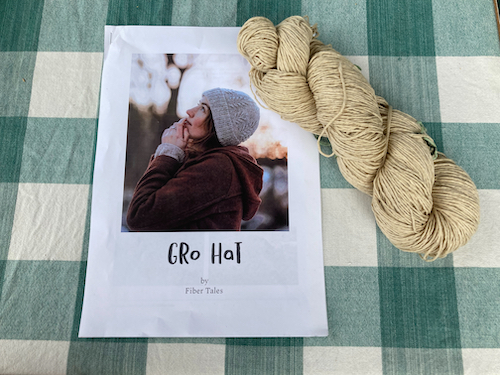
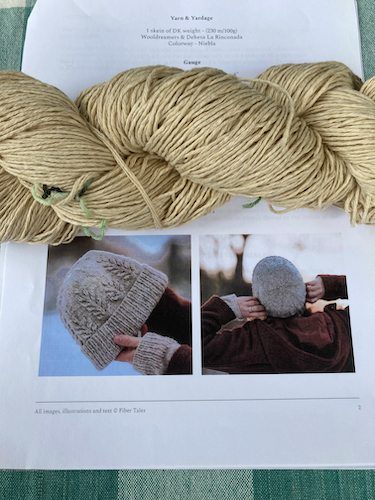
The pattern calls for one 100 gram skein of DK (double knit) yarn, and I knew I had a lot of undyed superwash DK possum/merino yarn (that I got from one of the Woolyarn outlet store sales when I lived in Wellington) in my stash.
I also knew what colour I wanted to dye the yarn. Back when I was living in Wellington I processed, dyed, spun, and knitted, a huge shawl for a Creative Fibre exhibition called the Southern Skies shawl using raw alpaca fleece a friend on a farm gave me. I had processed and dyed white alpaca fleece in sequential aurora colours based on a photo I had taken of an aurora, spun up each section of yarn, and then knitted the project, adding silver beads to show the constellations of the southern night sky.
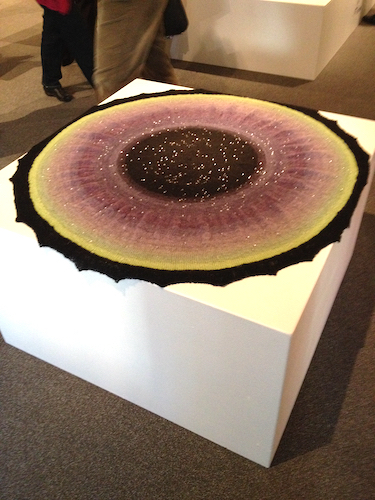
One of the colours in the shawl was a beautiful sage green, called Aurora 4 according to my dyeing notes, and this was the colour I wanted to dye for this hat project.
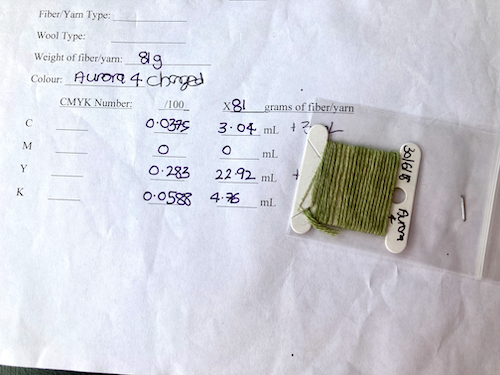
After checking my dyeing project notes I calculated how much dye I would need to add to this project. The total amount of yarn I chose for this project was 123 grams of undyed superwash yarn. I used more yarn than the pattern suggested, because it is good to have extra for swatching, and also to not have to play yarn chicken.
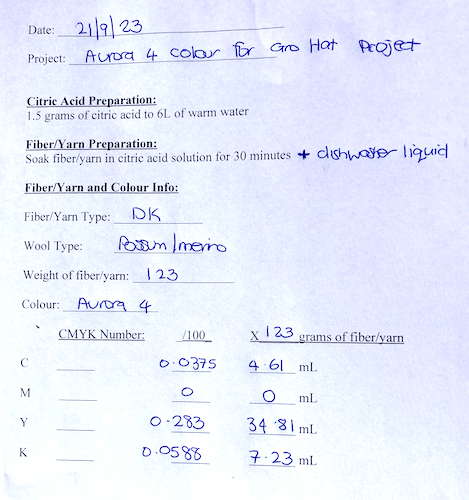
I've included in here my calculations for getting the aurora 4 colourway. When it comes to dyeing yarn, I used Ashford dyes, and mainly in the colours Teal, Hot Pink, Yellow, and Black, which are equal to Cyan, Magenta, Yellow, and Black. Combing these 4 colours can lead to an infinite number of colours. My Ashford dyes are made up as a 1% depth of shade (DOS) stock solution. For this project, I know the relative proportions of teal, yellow, and black I need to make the aurora 4 shade. I need to add 4.61 mL, 34.81 mL, and 7.23 mL of each respective dye stock solutions to dye 123 grams of possum merino yarn.
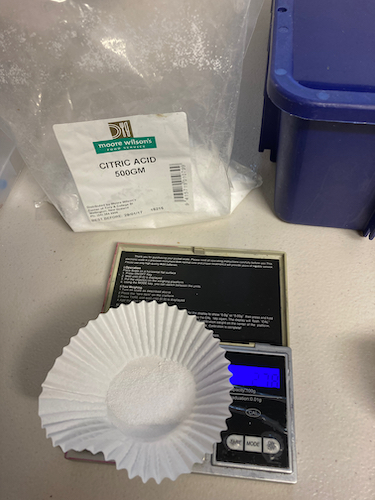
The first step in acid dyeing yarn is to make up the acid solution for dyeing. Ashford suggests to add white vinegar to make the water acidic, but it is horrible to work with when heated, and the fumes make my eyes water. So instead I have developed a system to use citric acid, which is easier to work with. To make up the citric acid water you add 1.5 grams of citric acid (which you can get from any supermarket) to 6L of water, and mix well. This is the solution you soak your yarn in, make up the DOS solutions, and also to dye in. To check the pH is at 4, I used a pH strip that I picked up from Trade Me.
The next step in dyeing is to pre-soak the yarn. Into a container add some of the citric acid water and also a splash of unscented Ecostore Dishwashing Liquid, followed by the yarn you want to dye. The dish washing soap is in there to help open up the fibers so that the whole skein of yarn is wet through and ready for dyeing. I usually leave this to soak for 30 minutes.
When it came to getting out the acid dye stock solutions, I had previously run out of yellow stock solution, so I had to make up a new batch. To 198 grams of citric acid water I added 2 grams of Ashford yellow dye. I measure this out into a paper muffin cup on a small scale that I picked up on trade me. With this step is important to wear gloves and a mask (I used a N95 mask), not only to not dye my hands, but also to protect my lungs from the fine dye mist.
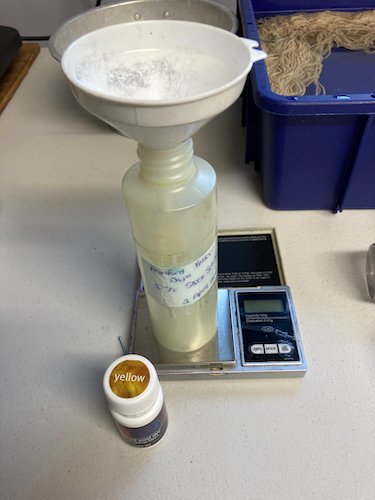
Once the yellow dye was well mixed, it was time to measure out the teal, yellow, and black stock solutions. After mixing each container well, I measured out each of the colours calculated above using plastic pipettes (which I also got from Trade Me) and the small scale and combined them. The aurora 4 colour was added to 6L of citric acid which was heating up in a stainless steel pot on the stove top, and mixed well. The yarn sitting in the solution was then wrung out and then added to the heating pot.
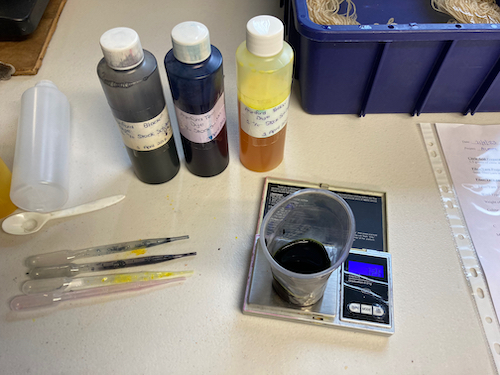
The yarn began to take up the dye straight away, and was gently mixed occasionally as the pot heated up to a simmer. The yarn and the pot was then left to simmer for 15 minutes. At the end of this time, the yarn had completely taken up the dye, and the citric acid water was clear when finished. The pot was turned off and left to cool.
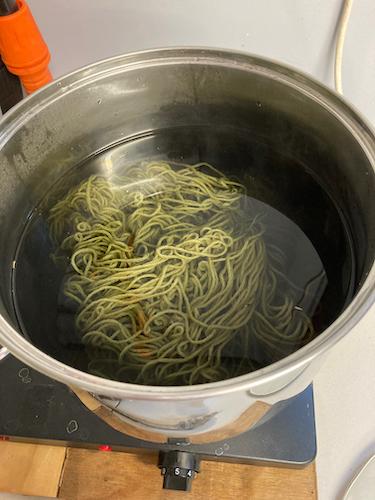
When the water had cooled, the yarn was removed from the pot. The citric acid water was left to cool to room temperature, and then baking soda was added to the water to return it to a pH of 7 (using a pH test strip), then discarded down the drain. The yarn was rinsed twice in luke warm water which had a little dish washer liquid added to it, not only to rinse out the citric acid water, but also to check that all the dye had indeed stuck permanently to the yarn. The yarn was then spun dry using the washing machine, and then left to dry outside.
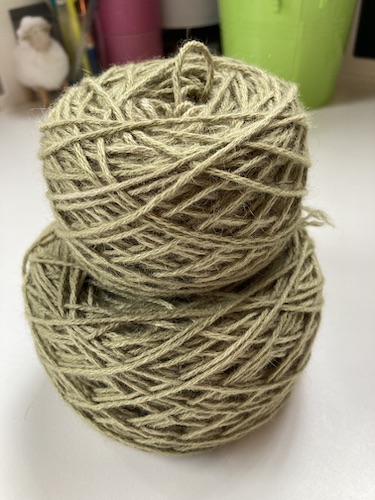
This is the finished yarn, and I'm really happy with it. I think because of the original colouring of the undyed yarn before dyeing, it's not quite the same as the sample yarn of the aurora 4 colour I have on file, but it's still close enough that I'm happy to start knitting with it.
Hopefully I'll have the hat knitted up over the coming spring and summer, so that it'll be ready to wear next autumn.
Have a wonderful day
Julie-Ann
Want to discuss my post? Feel free to chat with me on Instagram or Mastodon.
Social Media



Archives