
Tour de Fleece 2026 Wrap-Up
Hello friends,
It's hard to believe that Tour de Fleece 2026 has already come to an end. I've enjoyed taking part this year and spending the past few weeks using my spinning wheel and drop spindles. It has been an opportunity to slow down, work through some of my fibre stash I found in a previous blog post, and enjoy the process of making yarn.
I thought it would be fun to share everything I spun during this year's Tour de Fleece, along with a few thoughts on each project and what I learned along the way.
"Tequila Sunrise" Corriedale Batt

Fibre: Corriedale
Colourway: Tequila Sunrise
Dyed by: Deepcreek Woolworks
Preparation: Batt
Weight: 20 g
As this was the smallest amount of fibre in my Tour de Fleece stash, I decided it would make the perfect warm-up project using my Majacraft Susie Pro spinning wheel. I split the batt in half lengthwise and spun each half using a short forward draw technique before plying them together into a two-ply yarn.

This was my first time spinning fibre from Deepcreek Woolworks, so I was curious to see how it would spin up. Overall, it spun well, although I found the fibre a little drier than I'm used to. There were also some small slubs and short fibre ends throughout the batt. As Deepcreek Woolworks is a relatively new fibre producer using wool from their own sheep, I wasn't too concerned by these minor inconsistencies and will be interested to see how their fibre develops over time.


The finished yarn measured 34.5 metres of two-ply yarn—a colourful little skein and a great way to begin this year's Tour de Fleece.
"Big Eared Wooly" Corriedale/Merino/Silk Batt

Fibre: Corriedale/Merino/Silk
Colourway: Big Eared Wooly
Dyed by: Dark Harbour Yarn
Preparation: Batt
Weight: 41 g
With my warm-up project complete, I was ready to move on to something a little bigger. My next project was a Big Eared Woolly batt, spun on my Majacraft Susie Pro spinning wheel. As with the previous batt, I split the fibre in half lengthwise. This time, however, I decided to spin it using a woollen long draw before plying it into a two-ply yarn. I was keen to practice my long-draw technique, and see how this fibre responded to this method.


Nikki Jones of Dark Harbour Yarn is a master of dark, moody colourways, and I'm a huge fan of her fibre and yarn. Spinning this rich green batt was wonderful. The colours have incredible depth and complexity, with tonal variations that revealed themselves as the yarn came together. The finished two-ply yarn is soft and squishy, exactly the kind of yarn I hoped to achieve with the woollen long-draw technique.


The finished yarn measured 87 metres of two-ply yarn—a beautifully soft, lofty skein and one of my favourite spins from this year's Tour de Fleece.
"Wrinkle-Lipped Free-Tailed" Corriedale/Merino/Silk Batt

Fibre: Corriedale/Merino/Silk Noil/Tencel
Colourway: Wrinkle-Lipped Free-Tailed
Dyed by: Dark Harbour Yarn
Preparation: Batt
Weight: 57 g
My next project was another Dark Harbour Yarn batt, this time the Wrinkle-Lipped Free-Tailed colourway, again spun on my Majacraft Susie Pro spinning wheel. As with the previous batts, I split the fibre in half lengthwise. This time however, I spun the fibre on the fold, before plying it into a two-ply yarn. The spinning on the fold technique produces a semi-worsted yarn with a lovely balance of loft and structure, while helping to control slippery fibres in the blend, such as silk noil and tencel.


Spinning this moody blue batt using the spinning-on-the-fold technique was a lot of fun. The finished two-ply yarn is airy and soft, and exactly the kind of yarn I was hoping to achieve with this semi-worsted spinning method.


The finished yarn measured 94.5 metres of two-ply yarn, creating a lofty, soft heathered skein in shades of blue.
"Moonlit Amethyst" Merino/Silver Nylon Glitter


Fibre: Merino/Silver Nylon Glitter
Colourway: Moonlit Amethyst
Dyed by: Myself
Preparation: Batt
Weight: 43 g
I wasn't entirely sure how to spin my Moonlit Amethyst merino and silver nylon batt, but the fibre eventually chose the method for me. My first attempt was a short forward draw on my Majacraft Susie spinning wheel, but I quickly discovered that the silver nylon fibres were separating from the merino, and drifting all over my lap and the floor.


Instead, I switched to a woollen long draw technique, which trapped the silver nylon fibres within the merino much earlier in the drafting process. This dramatically reduced the amount of sparkle escaping onto my lap and the floor. The fibre spun up quickly using this technique, producing a yarn that is very soft thanks to the merino. However, in places where the silver nylon fibres became more concentrated, the yarn felt scratchier to the touch.


The finished yarn measured 85 metres of two-ply yarn and is wonderfully soft and squishy, with all the characteristics you'd expect from a predominantly merino yarn. Although the silver nylon isn't completely embedded into every section of the yarn, this project proved to be a valuable experiment in discovering the best way to spin this fibre blend.
Ashford Cinnamon Merino/Silk Sliver


Fibre: 80% Merino/20% Silk Sliver
Colourway: Cinnamon
Dyed by: Ashford
Preparation: Sliver
Weight: 100 g
This project wasn't originally part of my Tour de Fleece plans. While we were visiting Christchurch, I stopped by the Ashford Factory Shop in Ashburton and couldn't resist picking up some of their beautiful cinnamon merino/silk sliver, along with a new drop spindle. Most of this yarn was spun in the evenings whenever I had the chance. It became a relaxing little side project alongside my wheel spinning, and the perfect opportunity to practice spinning with my new drop spindle.

As always, Ashford's Merino Silk Sliver was a pleasure to spin. It drafted well on my new drop spindle, and it was satisfying to watch the warm cinnamon tones gradually emerge as the yarn came together. The slow pace of drop spindle spinning means this project is still ongoing, but I'm looking forward to picking it up whenever I have a quiet moment over the coming months.


Overall, during Tour de Fleece 2026 I completed four projects, spinning a total of 602 metres of fibre, which became 301 metres of finished two-ply yarn. It wasn't my biggest Tour in terms of metreage, but that was never the goal. Instead, I wanted to make a start on reducing my fibre stash while practising a variety of spinning techniques. And looking at the extra space in my fibre storage container, I'd say it was a very successful Tour.
Thank you for following along on my Tour de Fleece 2026 journey. I hope you've enjoyed all the squishy fibre content as much as I've enjoyed creating it.
Have a wonderful day,
Julie-Ann
If you'd like to continue the conversation, you can find me on Instagram, Mastodon, Bluesky, and Facebook.
End Of Year 2025 Spinning Projects
Hello friends,
In the spring of 2025 I managed to accomplish a couple of spinning projects using my drop spindle and spinning wheel, spinning up two braids of fibre I had in my stash.
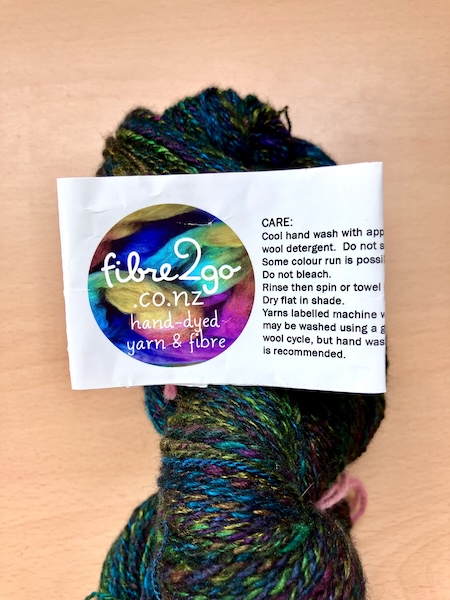
First up was 100 grams of Fibre to Go "In The Shade Jewels" braid, made from 70% merino and 30% Silk, that my best friend Karyn picked up for me at Fibretron in Hamilton in the winter of 2025. Unfortunately after searching through all my photos I couldn't find any pictures of the braid, or of it being spun up on my drop spindle, but here is the finished yarn in all it's glory.
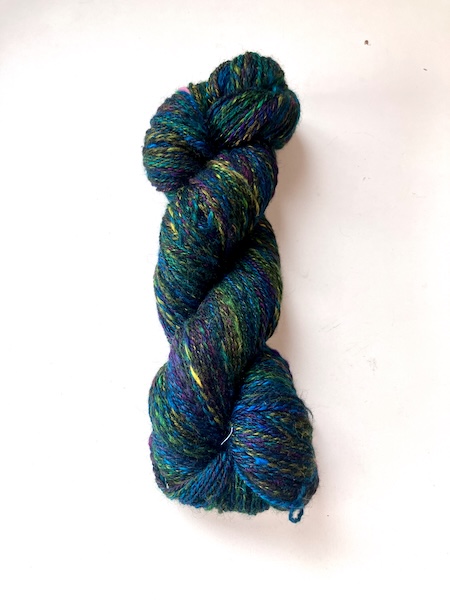
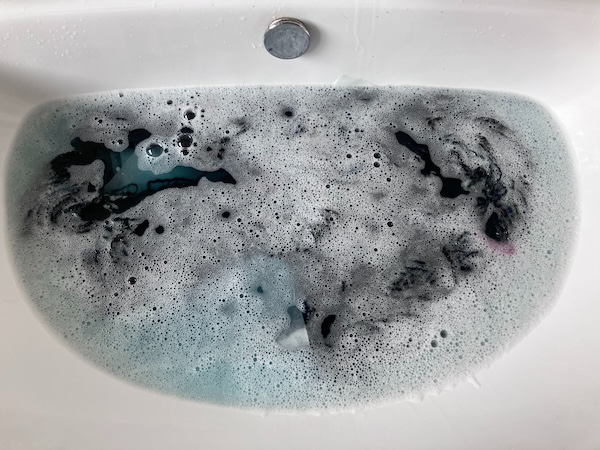
The rainbow jewel shades against the black are just so pretty, and I can't wait to use it in a weaving project in the near future. Unfortunately the yarn colours ran when I washed the skein of yarn after plying, but it did clear up in the rinses afterward. This yarn ended up being fingering weight width.
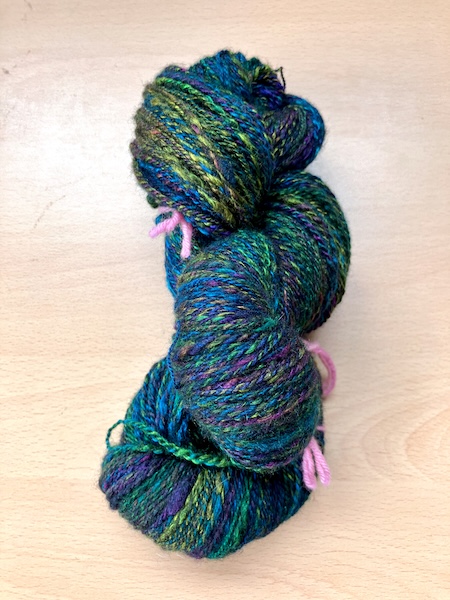
And secondly, I spun up a 100 gram braid from Handmaiden's July 2025 Fibre Club, containing 75% Corriedale, 15% Llama, and 10% Rayon, in shades of graduated pink, purple, blue and white.
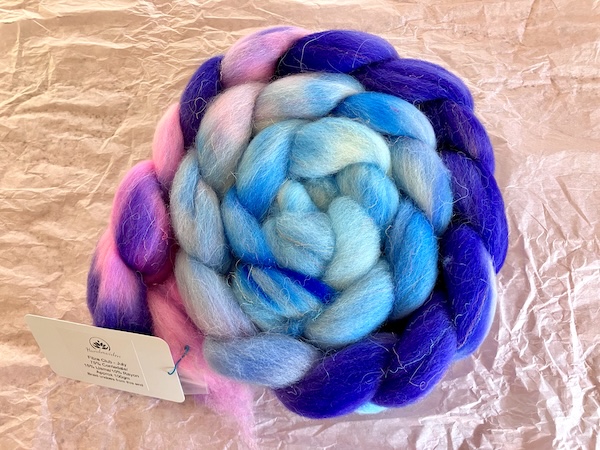
With the rayon content being flecks of fibre that would come out easily all over the place while spinning, I decided to spin it with a high twist on my spinning wheel, in order to reduce the amount of mess all over me and my craft room floor. I split the braid vertically down middle to retain the colour changes in the braid, and then spun up the two singles in the same direction, followed by plying them together as a simple 2-ply yarn. The resulting yarn was my usual fingering weight yarn width.
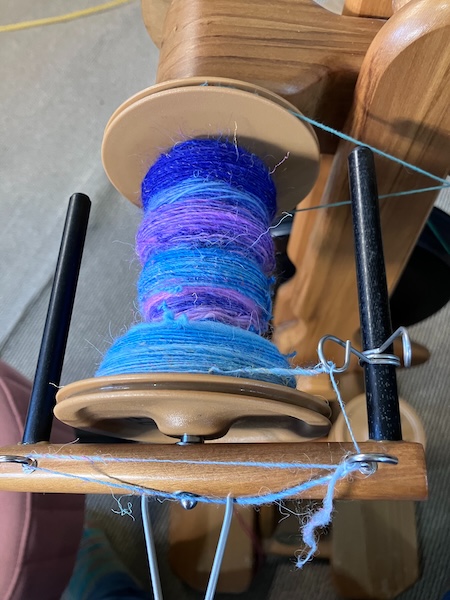
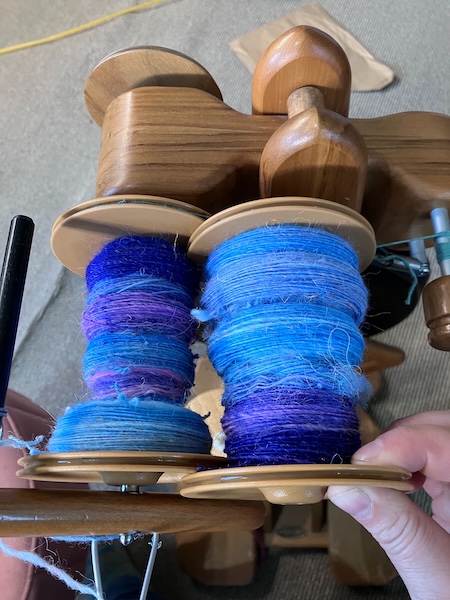
The resulting yarn mostly kept the colours and colour graduation together, but there is always some sort of shifting that happens due to unbalanced dyeing on each side of the braid, as well as uneven splitting of the braid when pulled apart.
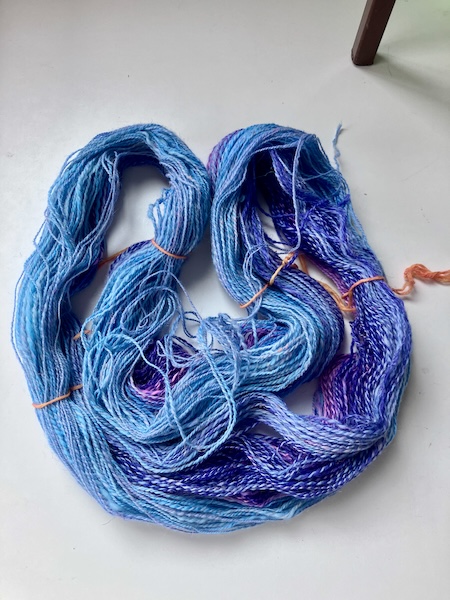
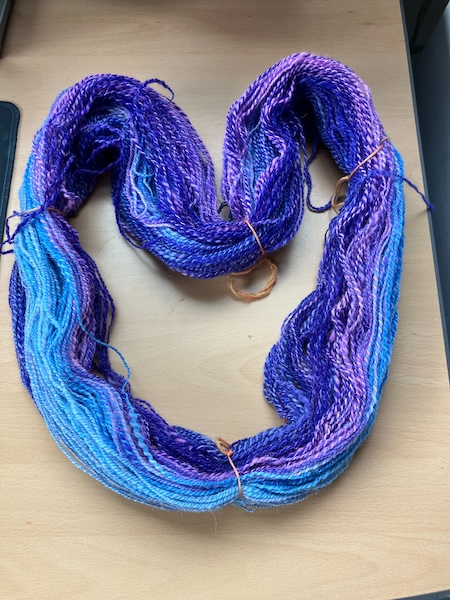
The yarn was then set in place using a gentle wool wash, and then dried, before being stored away in my large pile of hand spun yarn.
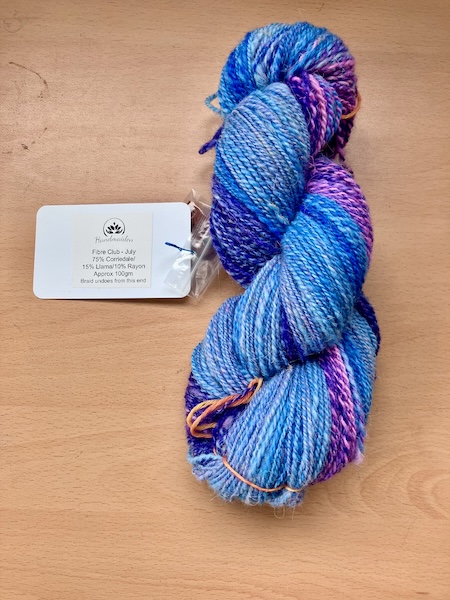
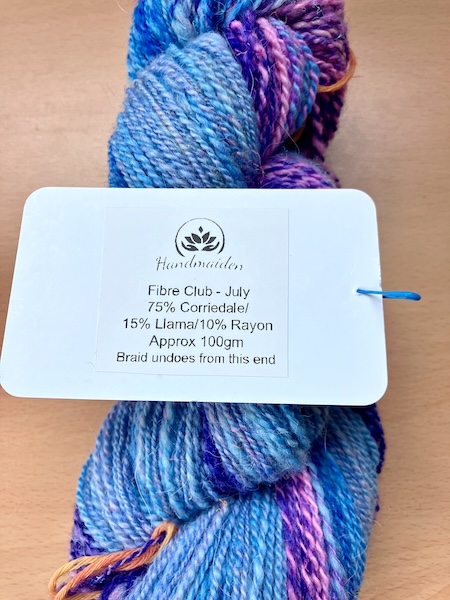
I'm very happy with the resulting yarn, and plan to use this yarn as a warp in an experiment to create a stained glass scarf for my online store Hearth and Oak. It is always very fulfilling to take a braid of fibre, and spin it, before weaving it into a finished project.
Have a wonderful day
Julie-Ann
Want to discuss my post? Feel free to chat with me on Instagram or Mastodon or Bluesky, and now also Facebook.
Spinning Union Fibre's Dyed Haunui Purple Roving
Hello friends,
Recently my friend Karyn was at Capital Fibre Fest in Wellington, and she knows I'm always on the look out for new fibre to spin on my drop spindle and spinning wheel, and she came across Union Fibre's booth, where Bonnie had for sale a bunch of different colourways. Karyn chose two rovings for me, in colours she knew I would l love.
First for me to spin up was a 100 gram roving of purple Union Fibre colourway (colourway not labelled on the paper wrapping), dyed with of medium Haunui Fibre.

Haunui fibre comes from a breed of sheep known as Haunui, which is grown on a family farm based in the foothills of South Canterbury, New Zealand. Haunui are known for its lustrous fibers and strong crimp, and it strikes a beautiful balance between softness and durability.

As I began spinning up the Haunui fibre on my drop spindle, the fibre was indeed soft and easy to spin, much more than Romney and Corriedale. It was such a pleasure to spin over the coming hours and days.


Once the drop spindle became full, I transferred it onto bobbins on my Majacraft Suzie Pro. I prefer to ply on my spinning wheel, as this is much easier than faster than on a drop spindle.

Once the fibre was fully spun up on two bobbins, it was time to ply the yarn as a two ply. It didn't take very long at all to ply on my jumbo plying bobbin.


Once transferred to a niddy noddy, the purple and brown shades of the dyed yarn really showed how beautiful the yarn was all spun up.


After a quick wash in some wool wash, the yarn was left to dry in the dining room in front of the winter fires over the coming days.

The final 100 gram 2 ply dyed yarn is of fingering weight/4 ply width, and came out at a total of 285 metres all spun up.


I really love how deep and cozy the shades of purple and brown look in the yarn. I'm not sure what I'm going to do with the spun yarn, sometimes it's just fun to spin for the hell of it. It'll eventually find a home in a knitting or weaving project in the future. For now it's just nice to have on display, and to squish it sometimes...
Have a wonderful day
Julie-Ann
Want to discuss my post? Feel free to chat with me on Instagram or Mastodon or Bluesky.
May Handmaiden Spinning Fibre Club
Hello friends,
Today I'd like to share with you my May Handmaiden Spinning Fibre Club subscription, and how it looks now all spun up.
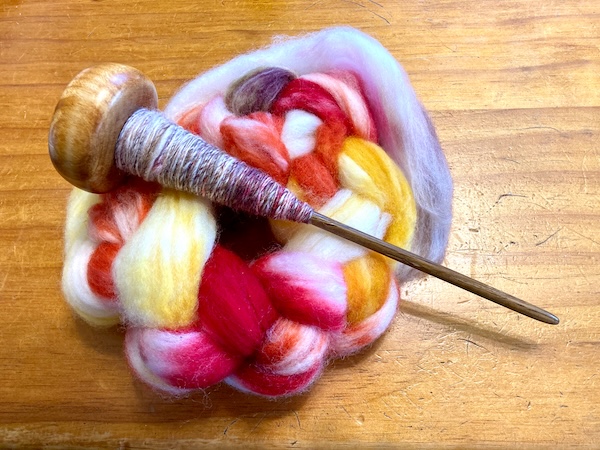
May's Handmaiden Fibre club, in autumnal shades of white, brown, orange and red, arrived all prettily wrapped up in tissue paper, and contained 100 grams of 80% machine-washable wool/20% nylon, a small plastic sock stitch marker, and a pattern for making Tinker Bell slippers. I decided to spin it up fine so I could make socks, so I broke the fibre braid in half to make a 2-ply, and then pulled out my trusty rimu drop spindle and got to work.
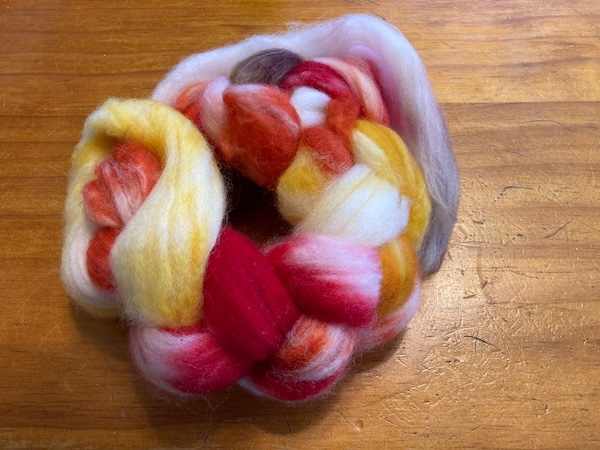
I love spinning with my drop spindle, because it's the easiest way to spin up super fine yarn for making socks, and it also increases the spinning time, which I find very relaxing. It took me a couple of weeks to spin up the two fine singles, and I loved the slow changing autumnal colours on my drop spindle as I spun.
I transferred the singles of yarn off the drop spindle and onto two spinning wheel bobbins for plying. Once that was done it didn't take very long at all to ply up the resulting 2 ply yarn on my Majacraft Suzie Pro spinning wheel. I prefer plying on my spinning wheel, as my drop spindle can't handle large amounts of plied yarn.
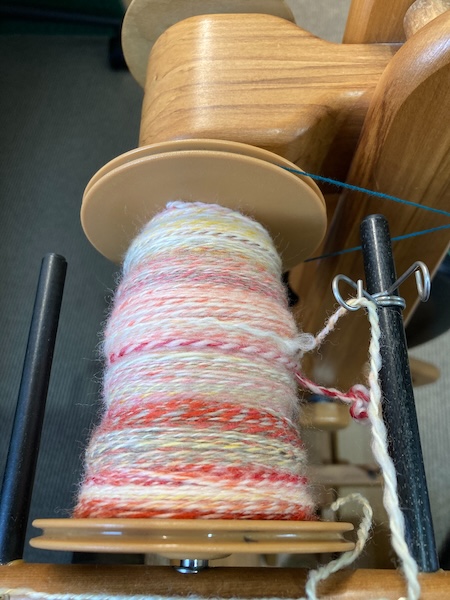
The plied yarn was in general fingering weight, and the autumnal colours were very pretty. After the plied yarn rested for a couple of days, I set the yarn by washing it in luke-warm soapy water.
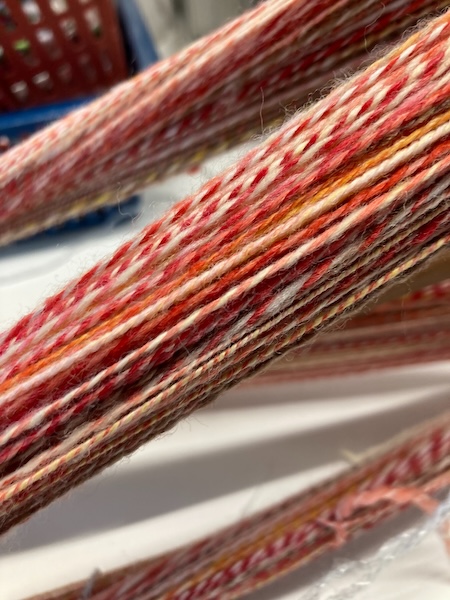
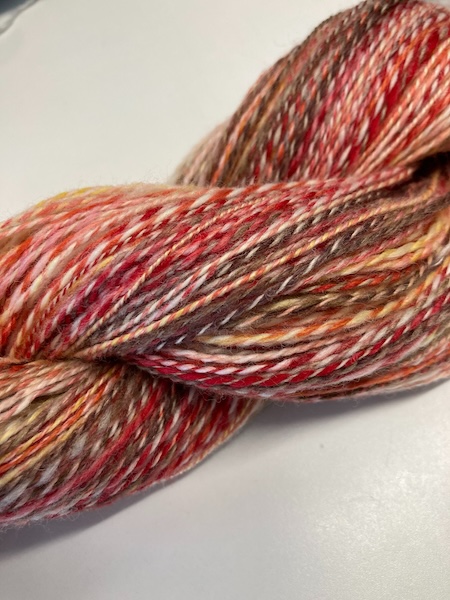
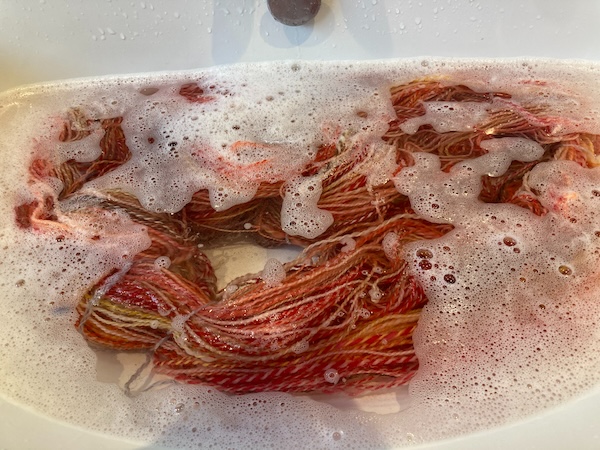
The yarn is now all dry, and waiting to be knitted up. The final yarn is 2 ply, and is 265.5 m long.
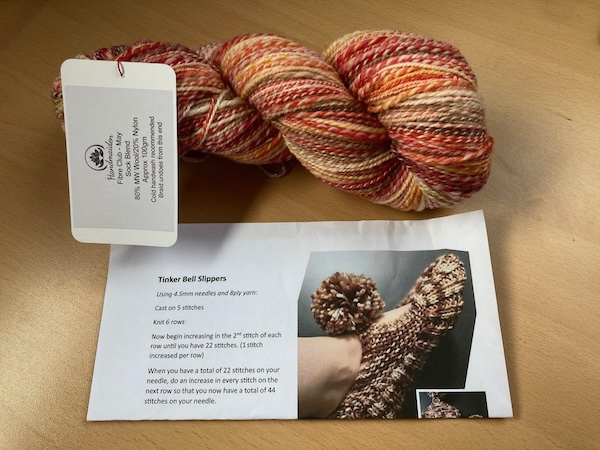
Once a couple of other knitting projects are completed, I will be knitting up this hand spun yarn into socks.
Have a wonderful day
Julie-Ann
Want to discuss my post? Feel free to chat with me on Instagram or Mastodon or Bluesky.
Social Media



Archives